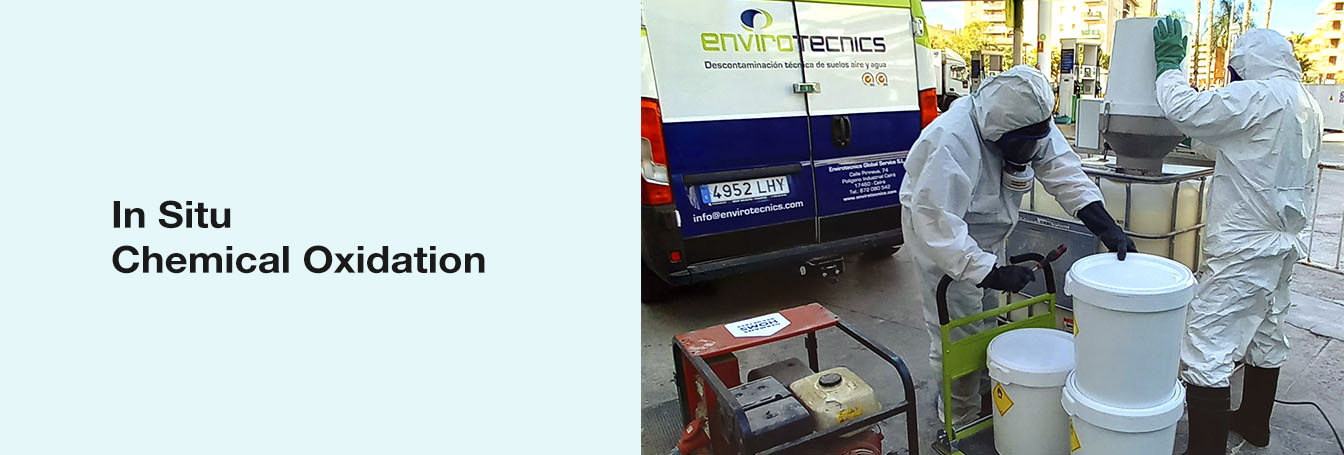
ISCO: In Situ Chemical Oxidation for the remediation of soils and groundwater

ISCO: In Situ Chemical Oxidation for the remediation of soils and groundwater

Published 08/25/2026

IN SITU REMEDIATION · CHEMICAL OXIDATION · ISCO

ISCO: in situ chemical oxidation for soil and groundwater remediation

In situ chemical oxidation makes it possible to act directly on contamination in the subsurface, but its effectiveness does not depend solely on the oxidising capacity of the reagent. The design must consider the contaminant, the hydrogeological setting, oxidant demand and, especially, the ability to deliver the reagent to the target zone.

In situ chemical oxidation (ISCO, In Situ Chemical Oxidation) is one of the remediation technologies used to reduce the mass of contaminants present in soil and groundwater by applying oxidising agents directly into the subsurface.

Unlike strategies based exclusively on extraction and on site treatment, ISCO acts on contamination directly at the site and can be particularly useful in source zones, hard-to-access contamination, or sites where excavation or intensive extraction are not viable.

The oxidising capacity of a reagent is important, but on its own it does not guarantee treatment effectiveness. The oxidant must reach the contamination, remain available for the required period and react preferentially with the target contaminant.

However, applying ISCO is not simply a matter of selecting an oxidant and dosing it. Treatment effectiveness depends on the interaction between the contaminant, the oxidant and the hydrogeological setting, as well as on the ability to distribute the reagent throughout the target zone.

For this reason, preliminary site characterisation and oxidant selection are fundamental aspects in the design of any ISCO treatment.

Contaminants Type and concentration of the contaminants.
Contaminant distribution Distribution of contamination in soil and groundwater.
Site characteristics Lithology, permeability and heterogeneity of the ground.
Organic matter Presence of natural organic matter and other oxidisable compounds.
Oxidant demand Natural oxidant demand of the ground (SOD/NOD).
Geochemical conditions pH, alkalinity, iron and other elements present.
Oxidant distribution Accessibility and ability to distribute the oxidant.
Reaction time and objectives Reaction time and contaminant reduction objectives.

Main oxidants used in ISCO

At Envirotecnics, we work with different families of oxidants, allowing the treatment strategy to be adapted to the specific characteristics of each site.

Oxidant 01

Sodium permanganate

Sodium permanganate (NaMnO4) is a widely used oxidant in groundwater remediation, particularly for the treatment of chlorinated solvents such as TCE and PCE, as well as other compounds susceptible to oxidation.

Its main advantages include its relatively high stability in the subsurface and reaction kinetics that can allow the oxidant to remain present for extended periods, promoting its distribution and contact with the contamination.

It is particularly useful when relatively high oxidant persistence and prolonged activity within the treatment zone are required.

As a drawback, reactions with the soil matrix and other compounds present in the subsurface can generate significant oxidant demand. In addition, the formation of manganese dioxide can alter environmental conditions and, under certain circumstances, affect permeability or the subsequent distribution of reagents.

Typical applications: chlorinated solvents, certain hydrocarbons and other oxidisable organic compounds.
Oxidant 02

Sodium percarbonate

Sodium percarbonate (2Na2CO3·3H2O2) is a solid source of hydrogen peroxide that can be used as an alternative for generating oxidising species in the subsurface.

Its solid form facilitates certain application strategies and makes it possible to design treatments where progressive oxidant release is desired. It can be used in different configurations, including systems combined with activation mechanisms to increase oxidative capacity.

One of its advantages is flexibility in application and storage, particularly compared with systems based directly on liquid H2O2.

However, its behaviour depends on site conditions and on the formulation and activation system used. As with other oxidants, the natural oxidant demand of the ground can consume a significant proportion of the reagent before it reaches the target zone.

Potential applications: hydrocarbons, BTEX, certain aromatic compounds and other oxidisable organic contaminants, depending on site conditions.
Oxidant 03

Sodium persulfate

Sodium persulfate (Na2S2O8) is one of the most versatile oxidants used in ISCO because of its ability to generate highly reactive species, particularly when activated by thermal, alkaline, metal-based or other activation mechanisms.

Its main advantage is precisely the versatility of the persulfate/activation system, which allows reactivity to be adapted to the contaminant and subsurface conditions.

It can be particularly suitable for contamination by hydrocarbons, BTEX, PAHs, certain chlorinated solvents and other organic compounds, although effectiveness must be assessed specifically for each contaminant and matrix.

Because of this versatility, the design must pay particular attention to activation and geochemical conditions. Excessively rapid activation may cause the oxidant to be consumed before reaching the contaminated zone, whereas a reaction that is too slow may limit treatment effectiveness.

Typical applications: hydrocarbons, BTEX, PAHs, chlorinated solvents and other oxidisable organic contaminants.
Oxidant 04

Hydrogen peroxide – Fenton / Fenton-like systems

Hydrogen peroxide (H2O2) can be used in Fenton and Fenton-like processes to generate hydroxyl radicals (•OH), highly oxidising species capable of reacting rapidly with numerous organic contaminants.

The main advantage of these systems is their high oxidative capacity and rapid reaction rate, which can be particularly useful when rapid reduction of high concentrations of certain contaminants is required.

One of their limitations is precisely their high reactivity. H2O2 can decompose rapidly in the presence of certain minerals, organic matter or natural catalysts, reducing the fraction of oxidant available to react with the contaminant. In addition, pH control, iron availability and dosing are critical factors in Fenton systems.

Potential applications: hydrocarbons, BTEX, PAHs, phenols and other oxidisable organic contaminants.

Oxidant selection is a fundamental part of the design

There is no single oxidant that is universally optimal for every site. Each technology has different advantages, limitations and application conditions.

OxidantMain applicationsAdvantagesKey aspects to control
Sodium permanganateEspecially chlorinated solventsPersistence and relative stabilityOxidant demand, MnO2 and distribution
Sodium percarbonateHydrocarbons and organic compoundsSolid source of H2O2 and application flexibilityActivation, natural demand and distribution
Sodium persulfateHydrocarbons, BTEX, PAHs and chlorinated compoundsHigh oxidative capacity and versatilityActivation system and non-productive consumption
H2O2 / Fenton-likeHydrocarbons, BTEX, PAHs and phenolsHigh reactivity and rapid actionpH, iron, decomposition and reaction control

From laboratory testing to treatment design

Before defining an injection campaign, treatability studies and laboratory tests should be used to assess aspects such as oxidant demand, reaction kinetics, the required concentration, by-product generation and compatibility with the site’s geochemical conditions.

The design must then transfer these results to field conditions, taking into account hydrogeological heterogeneity, injection radius of influence, reagent distribution and the evolution of contaminant concentrations.

The ultimate objective is not simply to achieve a chemical reaction in the laboratory, but to ensure that the oxidant reaches the contamination, remains available for the necessary period and reacts preferentially with the target contaminant.

ISCO solutions adapted to each site

At Envirotecnics, we provide a range of oxidising solutions for ISCO projects, combining reagent supply with the technical expertise required to select the most appropriate alternative according to the contaminant and the specific conditions of each site.

In in situ remediation, selecting the oxidant is only the first step. The real challenge is designing how to deliver it to the contamination and make it work effectively in the subsurface.

Are you evaluating an ISCO strategy?

We can help you assess the most appropriate oxidant and application strategy according to the contaminant and site conditions.

Popular searches

Featured products

This website uses its own technical cookies and third-party statistical cookies.

If you click Accept all, you agree to the installation of all of them. If you click Decline we will not use cookies for any additional purposes. If you click Configure you can decide on their installation or not. You can withdraw your consent or resume it at any time on the Cookies Policy page of this website.

For more information about cookies, access the Cookies Policy.