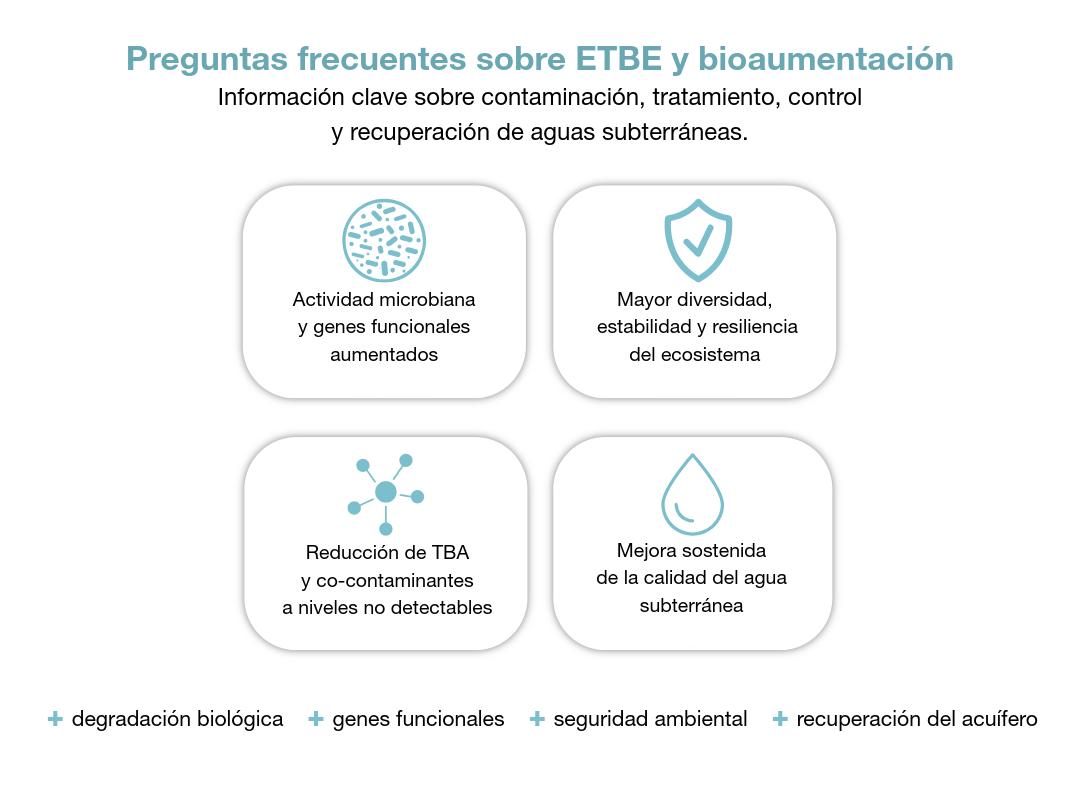
Frequently Asked Questions about ETBE and Bioaugmentation

Frequently Asked Questions about ETBE and Bioaugmentation

Published 07/31/2026

ETBE · BIOAUGMENTATION · FREQUENTLY ASKED QUESTIONS

Frequently asked questions about ETBE and bioaugmentation

We have compiled the most frequently asked questions about the behaviour of ETBE in groundwater, its biodegradation, and the application of bioaugmentation and biostimulation strategies.

View all questions →
161
DAYS

Pilot test duration

>11.000
μg/L/día

Initial ETBE concentration

+ 70 %

Concentration reduction

113–117
μg/L/día

Degradation rate achieved through bioaugmentation

ETBE and environmental behaviour
+ What is ETBE? Contaminant

ETBE, ethyl tert-butyl ether, is an oxygenated compound used as a fuel additive to increase the octane rating and promote more efficient combustion.

+ Why is ETBE difficult to degrade? Environmental behaviour

The high mobility of ETBE in aquifers, combined with its limited natural biodegradability and low adsorption to the geological medium, promotes the formation of persistent plumes that are difficult to treat using conventional biostimulation or natural attenuation strategies.

+ What is the difference between ETBE and MTBE? Oxygenated ethers

ETBE and MTBE are oxygenated ethers used as fuel components. They differ in their origin, physicochemical properties, biodegradability, and behaviour in the subsurface environment.

Bioaugmentation and biostimulation
+ What is bioaugmentation? Biological treatment

Bioaugmentation is a biological remediation strategy based on the controlled introduction of specialised microorganisms capable of degrading specific contaminants.

+ What is the difference between bioaugmentation and biostimulation? Biological strategies

Bioaugmentation introduces specialised microorganisms to enhance the system’s degradation capacity. Biostimulation promotes the activity of the microbial populations already present at the site by supplying nutrients, oxygen, or other elements required for the biological process.

+ What are the advantages of immobilised biomass? Bioaugmentation

Immobilisation can enhance cell retention, reduce biomass losses caused by hydraulic washout, and improve the microbiological stability and persistence of the treatment within the aquifer.

Degradation and microbiological monitoring
+ What happens to tert-butanol during ETBE degradation? TBA

Tert-butanol, or TBA, is one of the main intermediate metabolites generated during ETBE degradation. Its evolution must be monitored to verify that the process continues through to complete degradation.

+ What are the ethB and alkB genes? Biomarkers

They are functional genes used as microbiological biomarkers. The ethB gene is associated with ETBE degradation processes, whereas alkB is related to the oxidation of aliphatic hydrocarbons.

+ How can it be verified that ETBE reduction is due to biological activity? Validation

Contaminant reduction is verified through hydrogeochemical monitoring and microbiological and molecular tools such as qPCR, RNA/cDNA analysis, NGS sequencing, and the quantification of functional genes associated with degradation.

Treatment application
+ Which products can be used for bioaugmentation and biostimulation? Remediation solutions

The solution must be defined according to the contaminant, hydrogeological conditions, oxygen and nutrient availability, and the specific treatment objectives. Depending on site requirements, nutrients, oxygen-releasing systems, specialised biomass, and technical surfactants may be used.

Do you have a site affected by ETBE?

We help you assess the case, define the remediation strategy, and develop the most appropriate technical solution.

Speak with a technical specialist

Related resource

Read the technical article on the bioaugmentation pilot test for ETBE degradation in groundwater.

View technical article →

Do you have a specific case to assess?

We analyse site conditions and define remediation strategies tailored to the contaminant, hydrogeology, and project objectives.

This website uses its own technical cookies and third-party statistical cookies.

If you click Accept all, you agree to the installation of all of them. If you click Decline we will not use cookies for any additional purposes. If you click Configure you can decide on their installation or not. You can withdraw your consent or resume it at any time on the Cookies Policy page of this website.

For more information about cookies, access the Cookies Policy.