
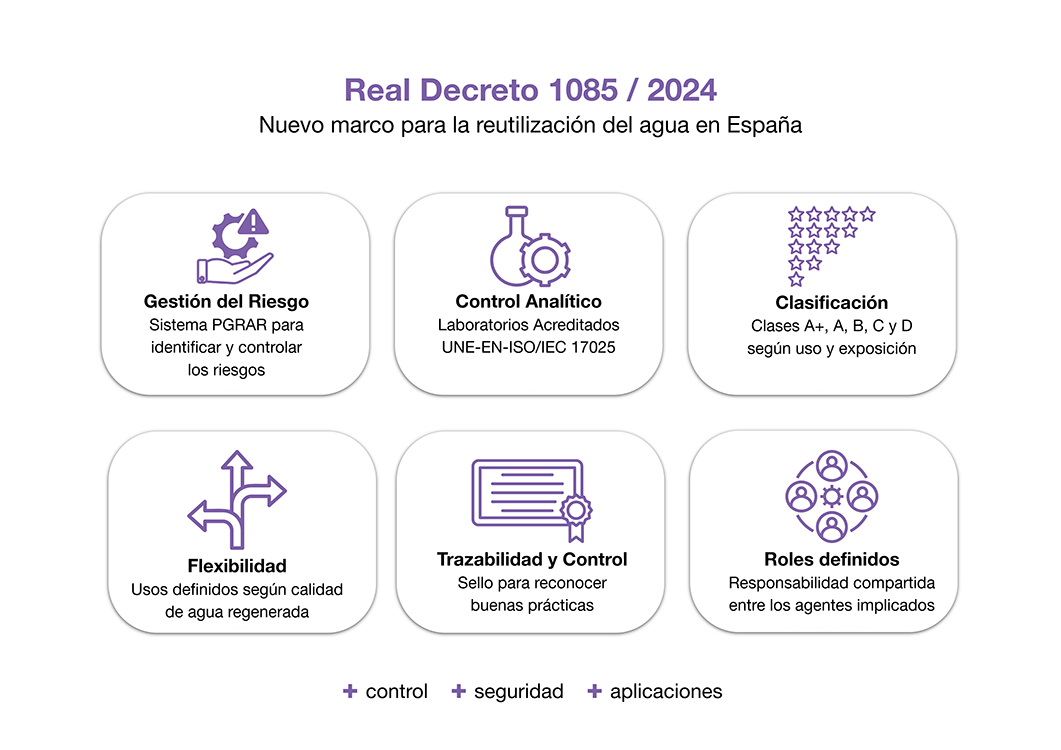
Royal Decree 1085/2024: Frequently Asked Questions on the Reuse of Reclaimed Water

Royal Decree 1085/2024: Frequently Asked Questions on the Reuse of Reclaimed Water

Published 04/17/2026

RD 1085/2024 · Frequently Asked Questions

What do you need to know about  water reuse in Spain?

We have gathered the most common questions raised by engineering firms, industries and public administrations before starting a project under the new regulatory framework.

View all questions →
5 water quality classes defined by use
2 responsible parties involved in reuse
PGRAR
mandatory for each project
100% risk management approach
What changes with RD 1085/2024
+ What is RD 1085/2024 and why does it replace the previous decree? Regulation

Royal Decree 1085/2024, published on October 22, 2024, replaces RD 1620/2007 and redefines the regulatory framework for water reuse in Spain.

The change responds both to the need to align with Regulation (EU) 2020/741 and to the intention of moving from a model focused on fixed parameters to one based on risk management, much better adapted to the actual use of reclaimed water.

+ What is the main difference compared to RD 1620/2007? Regulation

The main difference lies in the approach. The previous framework relied mainly on water quality tables associated with specific uses. The new decree, aligned with Regulation (EU) 2020/741, maintains analytical criteria but integrates them into a broader system based on risk management. This means it is no longer enough to simply “comply with a table”. It is now necessary to justify the intended use, assess exposure, establish control barriers and document everything within the WRRMP.

Water Reuse Risk Management Plan (WRRMP)
+ What is the WRRMP and why is it mandatory? WRRMP

The Water Reuse Risk Management Plan (PGRAR) is the core document of the new regulatory framework. It analyses the system, identifies health and environmental risks and defines prevention, control and monitoring measures.

It is mandatory because the decree no longer focuses exclusively on water quality and now requires proof that the final use is safe within its actual context.

+ What must the PGRAR include? WRRMP

The WRRMP must include, at minimum:

  • Description of the system and the stakeholders involved.
  • Assessment of health and environmental risks.
  • Definition of barriers and control measures.
  • Analytical monitoring and surveillance programme.
  • Incident response procedures.

Its preparation requires detailed technical knowledge of the resource, the intended use and the application environment.

Reclaimed water quality classes
+ What are the quality classes defined by RD 1085/2024? Quality

Royal Decree 1085/2024 establishes five quality classes: A+, A, B, C and D, ranked from highest to lowest level of requirement.

The choice of class depends on the intended use, the level of human exposure, the type of user and the risk associated with the final application.

+ Which analytical parameters must be monitored? Quality

For any quality class and for all uses, continuous monitoring of flow rate and turbidity is required at minimum.

+ What uses remain prohibited? Uses

The use of reclaimed water for direct human consumption remains prohibited, as well as any use where health risks cannot be properly controlled.

How to apply the regulation to your project
+ Where should a water reuse project start? Project

The starting point is analysing the available resource, the intended use and the associated risk. Before defining the technology, it is necessary to understand what type of water is available, what it will be used for and under which conditions it will be applied.

+ What technologies can be used for water reuse? Project

The regulation does not impose specific technologies, but rather results and guarantees. Depending on the required quality class and intended use, biological, physico-chemical, filtration, disinfection, membrane or other treatment barriers may be combined.

Does your project require a PGRAR?

We help you assess your case, define the required quality class and propose the most suitable technical solution.

Talk to a technician

Related resource

Read the complete technical summary of RD 1085/2024, including an analysis of the most relevant regulatory changes.

View regulation summary →

Do you have a specific project or case to evaluate?

We have been supporting technical projects in the water and environmental sector for more than 20 years. Tell us about your situation and we will provide initial technical guidance with no obligation.


This website uses its own technical cookies and third-party statistical cookies.

If you click Accept all, you agree to the installation of all of them. If you click Decline we will not use cookies for any additional purposes. If you click Configure you can decide on their installation or not. You can withdraw your consent or resume it at any time on the Cookies Policy page of this website.

For more information about cookies, access the Cookies Policy.